

Cooling Fan Technology by SANYO DENKI AMERICA
This site is part of SANYO DENKI’s official cooling engineering knowledge base.
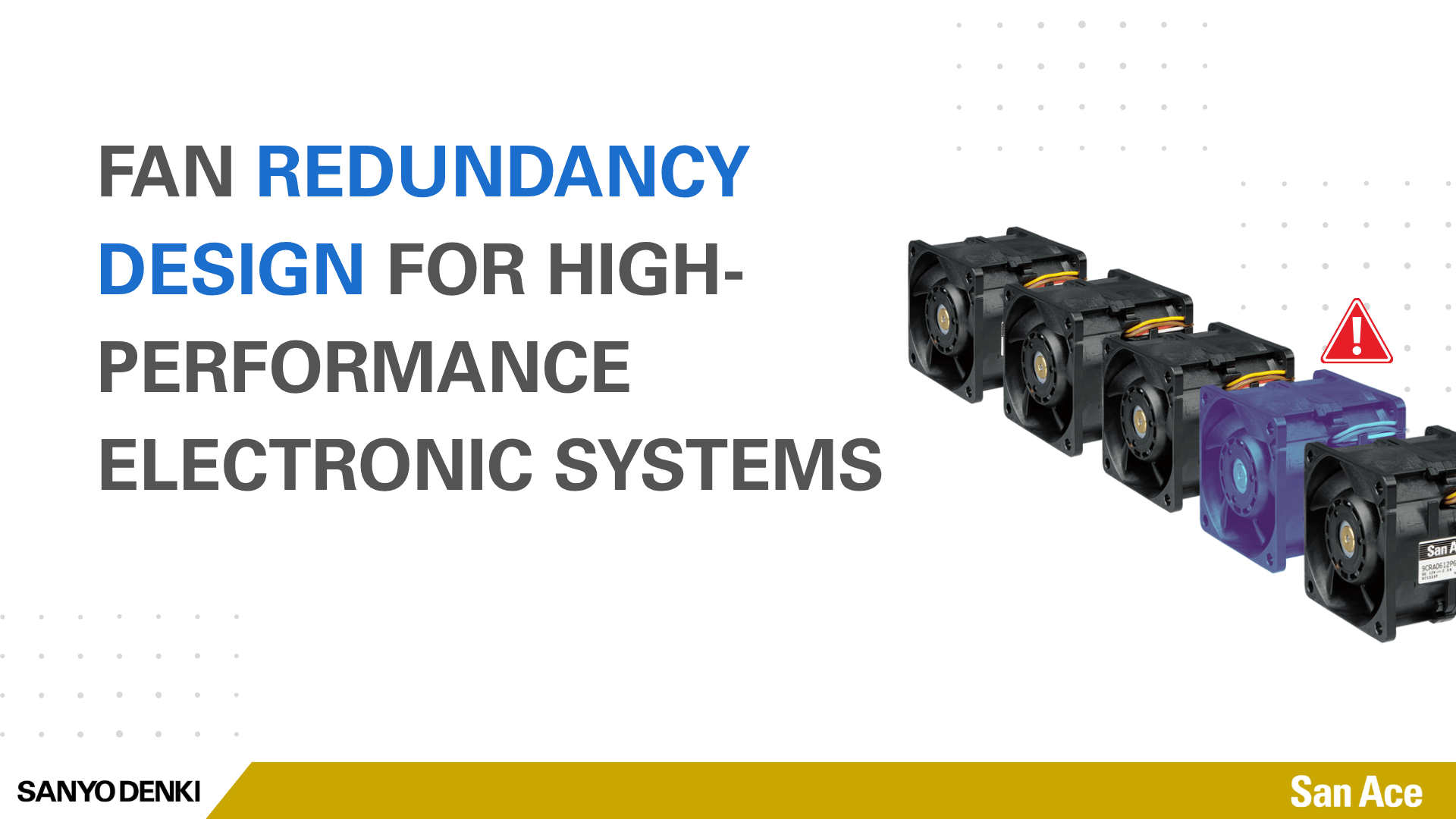
Data centers, network switching facilities and other critical systems must run 24/7, 365 days a year without fail. These systems depend on fans to keep them cool. Even the most reliable fans do fail, and when a fan fails, the system must keep running. That is the reason that these types of systems must be designed with fan redundancy.
N+1 fan redundancy adds one fan beyond the number required to meet the system’s cooling needs. For example, if a system requires four fans to meet its cooling requirements, a fifth fan is added to provide redundancy in the event of a fan failure.
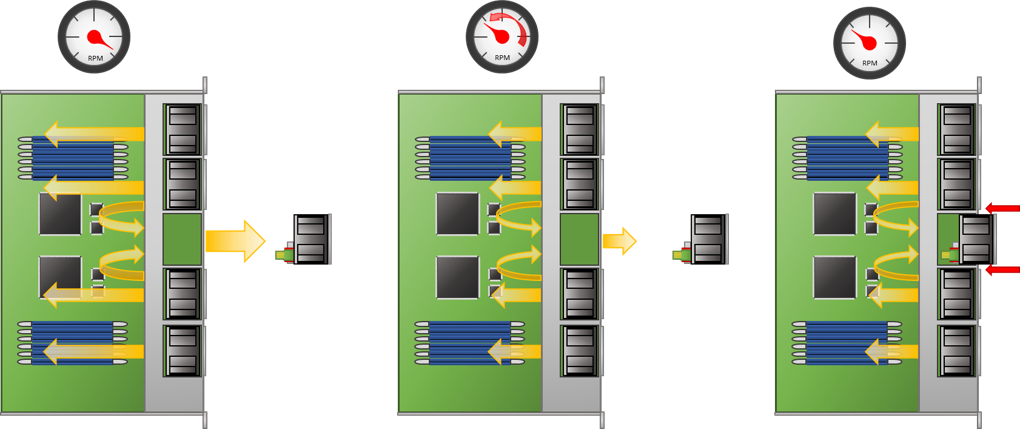
In a failure condition, all other fans will need to run at higher performance to compensate for the losses of the failed fan. With PWM control, any fan running below 100% PWM duty can be sped up to increase system airflow.
However, having an extra fan does not ensure adequate cooling if one fan fails. The remaining fans must still overcome the resistance of the equipment and move enough air through the system. How the fans are mounted and what happens to the airflow path when one stops can make a significant difference.
In a fan array, operating fans will create a pressure differential which can drive air backward through the stopped fan. Instead of sending all the available air through the intended cooling path, the system loses some of it through that opening, causing a short circuit in the airflow path.
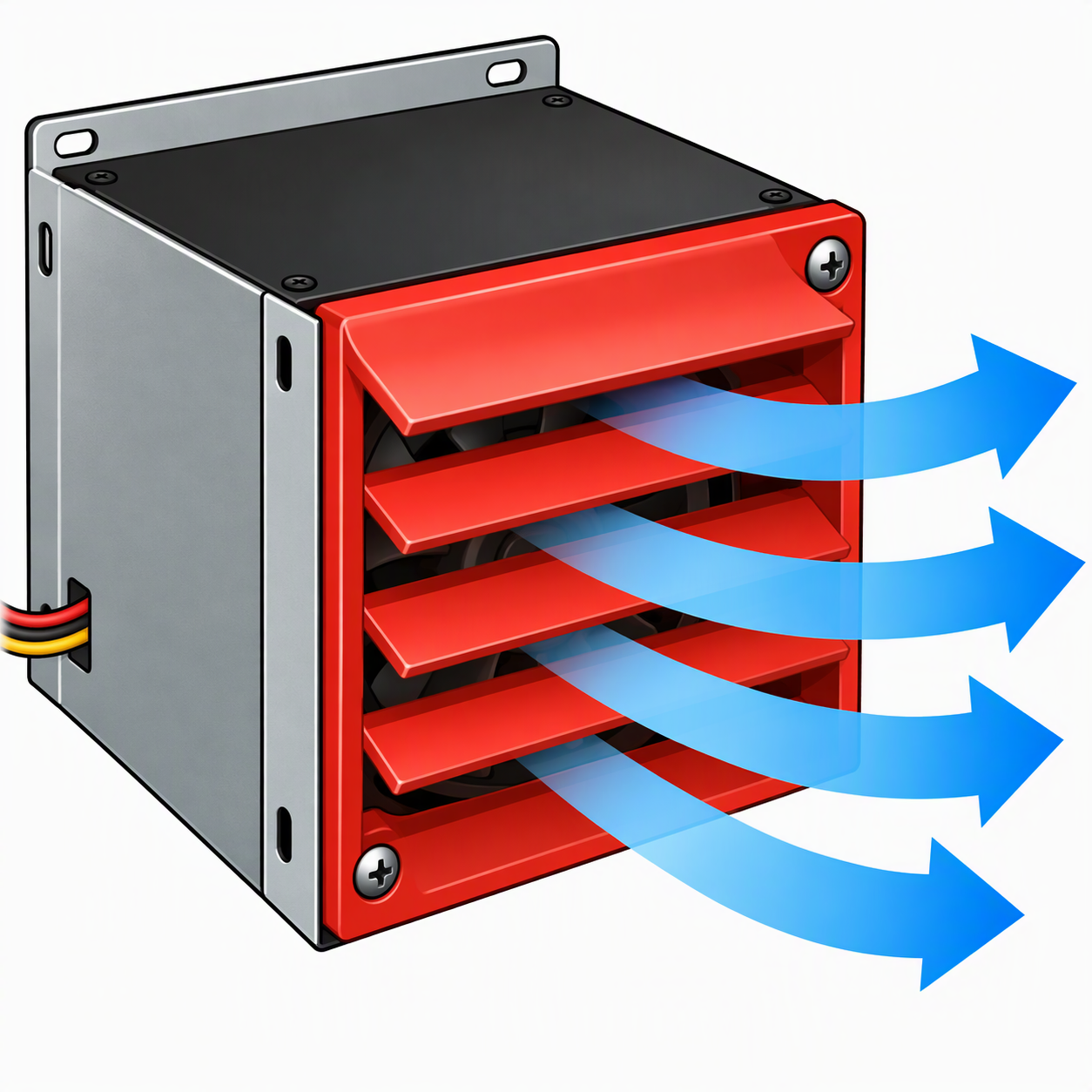
Fan louvers offer one way to address this problem. The louvers open in the normal airflow direction and will close when air tries to escape. This blocks the reverse flow path. For example, if the array has three fans and one fan fails, the two operating fans can continue pushing air toward the electronics while the shutter behind the failed fan remains closed, preventing reverse airflow through the failed fan.
There is a trade-off: even open louvers add some resistance. The fan and louver combination should be evaluated together, not assumed to perform like an unobstructed fan.
The system also needs to detect a fan failure. Most SANYO DENKI DC fans offer pulse sensor (tachometer) outputs that allow the system to monitor fan speed. If a fan drops below its expected speed, the system controller can identify the problem and respond.
Continuous monitoring and automated system response create a closed-loop process that helps maintain cooling and keeps critical equipment operational when a fan fails.
Most systems are designed so that the fans are driven below their maximum speeds during normal operation to limit noise and reduce power consumption. If one fan stops, the system can speed up the remaining PWM-controlled fans. This approach works only if enough additional speed and airflow capacity were built into the original design. The response should be checked against the system’s actual thermal requirements.
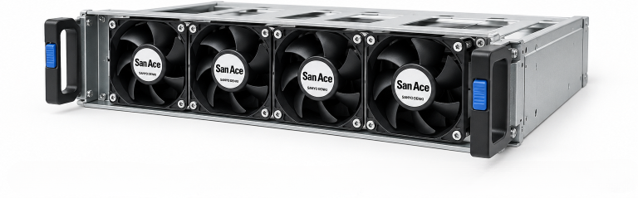
A redundant cooling design is much easier to maintain when a failed fan can be replaced quickly. In some systems, fans are packaged as hot-swappable field-replaceable units (FRUs), allowing a technician to remove a failed module while the other fans continue cooling the system. The failed fan can be quickly removed and replaced because the FRUs have blind-mate connectors that snap in and out.
SANYO DENKI can manufacture the complete custom fan tray or FRU—not just supply the fans. For example, a customer may design a tray with multiple San Ace fans, backdraft louvers, connectors, wiring, and a quick-release handle. Working from the customer’s drawings and 3D models, our team can review manufacturability, develop prototypes, source the components, and assemble the finished module.
The customer receives a complete assembly under one part number, simplifying both the service strategy and the procurement process. Hot-swap capability, however, must be designed and validated at the system level.
The best way to know whether redundancy works is to test it. Start with all fans operating, then simulate a failure and measure what happens to system airflow. Do the louvers close? Can the remaining fans maintain the required airflow? How much speed increase is needed? We can test all these parameters in our lab.
SANYO DENKI America has a fully equipped laboratory in Torrance, California, and offers complimentary system airflow testing to customers. Testing actual equipment can reveal restrictions that are difficult to predict from individual fan specifications alone.
The results can also help fine-tune everyday operation. If the system has adequate cooling margin, you may be able to select lower normal fan speeds to reduce noise and electrical power draw, while reserving higher speeds for demanding conditions or a fan failure. Any such settings still need to be validated against the full operating range, including high ambient temperatures and maximum heat loads.
A well-designed redundant cooling system is more than an extra fan. It combines an appropriate airflow path, failure detection, a practical replacement strategy, and testing to confirm the system performs as intended.
Contact a SANYO DENKI sales engineer to discuss redundant cooling designs, custom fan FRUs, and complimentary system airflow testing.
Written by Jim Cranney
This article is part of SANYO DENKI AMERICA’s San Ace cooling engineering knowledge base, sharing practical guidance engineers use when working with DC fans in electronic cooling designs.
SANYO DENKI has been a trusted provider of cooling solutions for various industries, with fans being a crucial component in many advanced devices. Contact us for a quote, or to discuss your device's customization requirements.
Our experienced application engineers and field engineers will provide support on the customization or any other technical support for your equipment. Contact our representatives or distributors to start discussing your next project.
Contact Us
