

Cooling Fan Technology by SANYO DENKI AMERICA
This site is part of SANYO DENKI’s official cooling engineering knowledge base.
Liquid cooling is emerging as a key technology for addressing higher-density computing, especially for artificial intelligence (AI) and high performance computing (HPC) applications. This leaves the question: do liquid-cooled servers still need cooling fans?
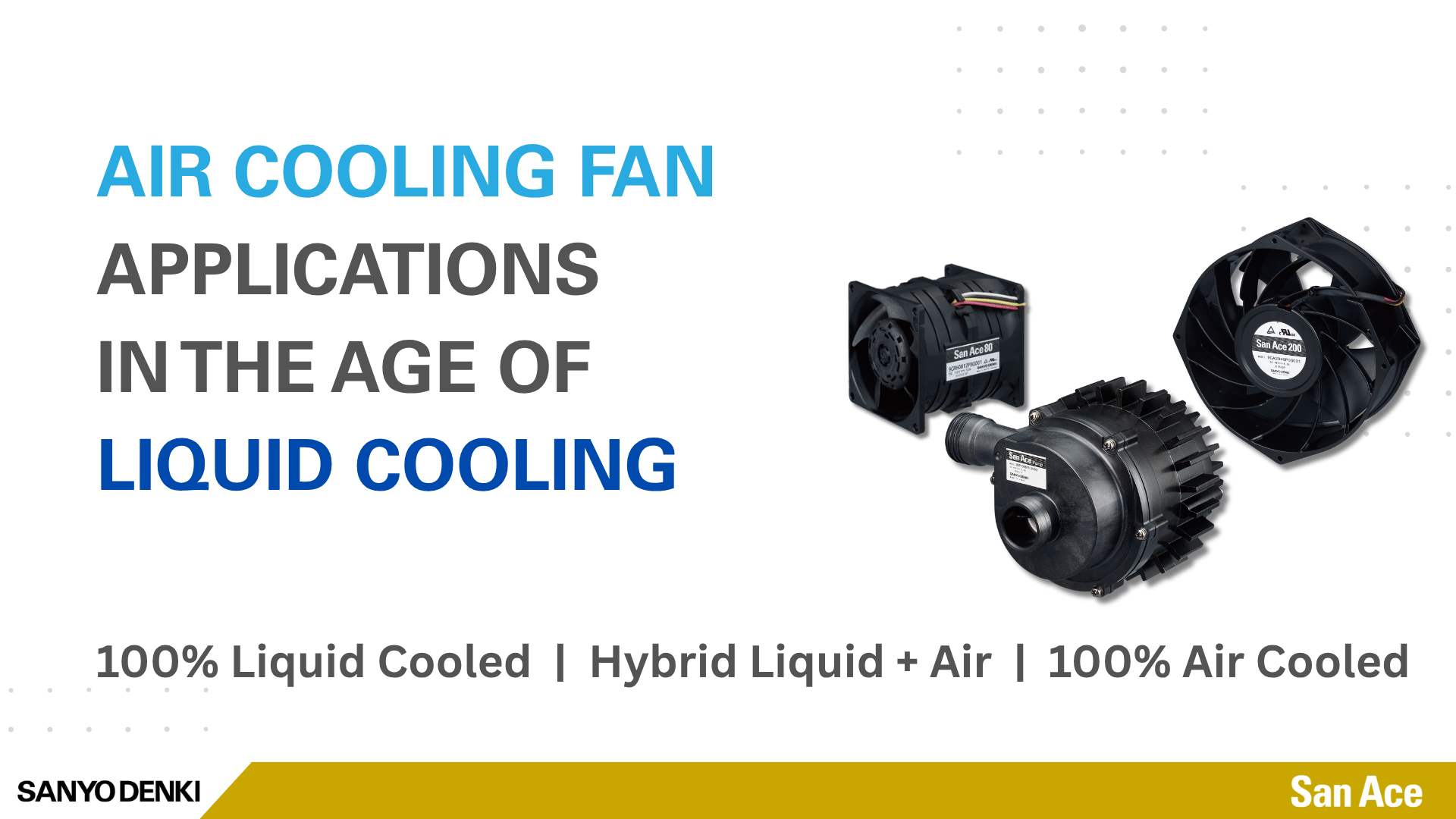
Server racks can be divided into three categories: 100% air cooled, hybrid air and liquid cooled, and 100% liquid cooled, and this blog will address all three types.
Even in newer data centers built with facility water systems, liquid cooling is used as a last resort when the thermal limits of air cooling are reached. This is due to the higher capital investment required for liquid cooling systems, which encompasses the facility retrofit such as water piping, direct-to-chip (D2C) cold plates in the server racks, pumps, controllers, filters, valves, pressure and flowrate sensors, etc.
For higher thermal density applications such as AI chips, high power CPUs and GPUs, designing a liquid cooling loop around these is a must. An example is NVIDIA’s HGX H100 8-GPU system, which has a thermal design power (TDP) of 5600W (700W x 8-GPUs). (More details here.)
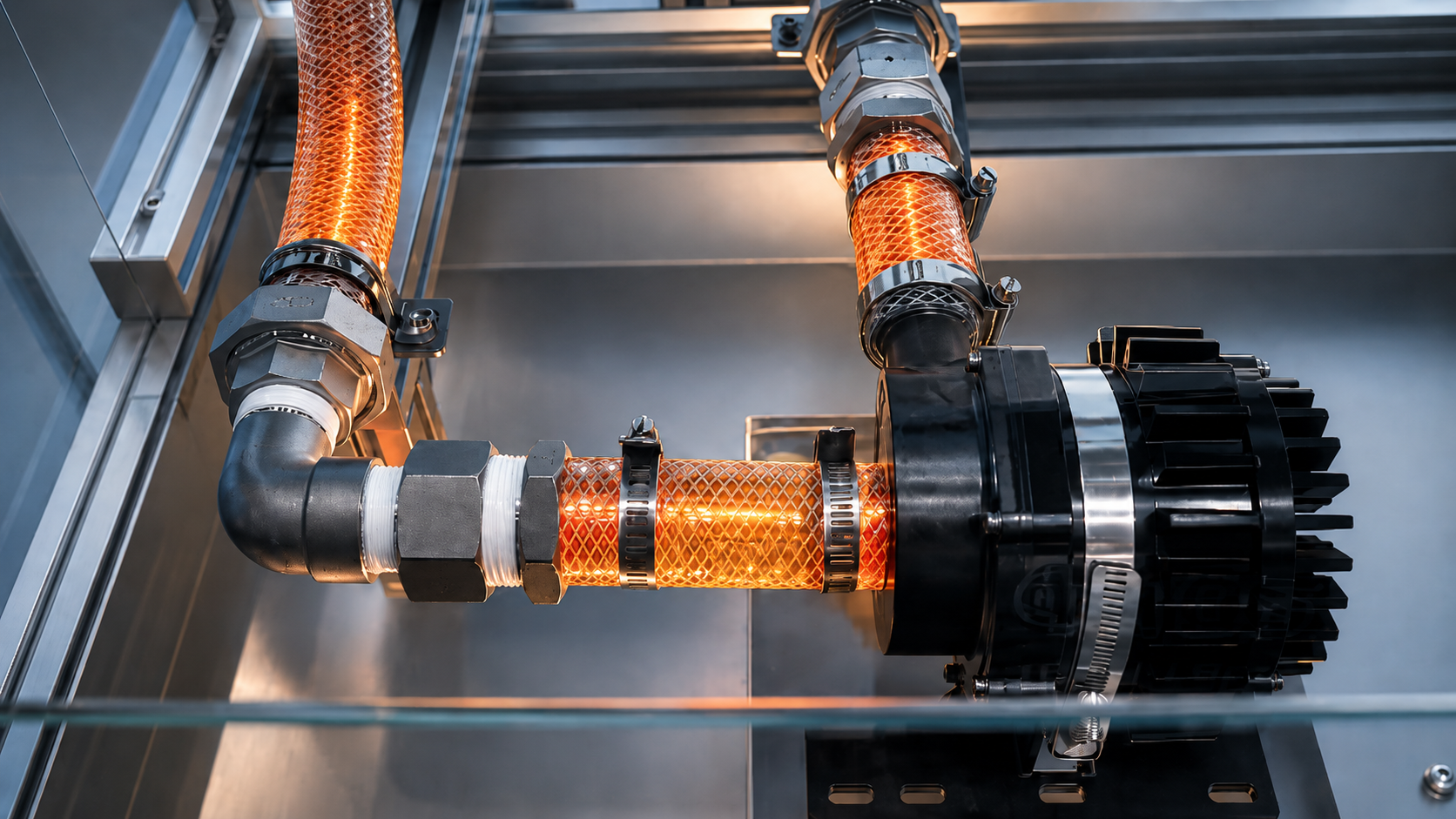
The coolant distribution unit (CDU) relies on high performance liquid pumps to drive conditioned coolant from its heat exchanger into the rack’s supply manifold. SANYO DENKI recently released a new liquid cooling pump for CDU applications, which is a crucial piece of a CDU when managing the precise pressure and flow rate required to circulate the cold inlet liquid and warm return coolant.
The rack’s vertical supply manifold and individual server chassis are fitted with quick-disconnect (QD) couplings. These couplings allow water or glycol mixtures (e.g., PG25) to flow from the manifold into the server’s liquid inlet lines, which directly supply the internal liquid loop and cold plates.
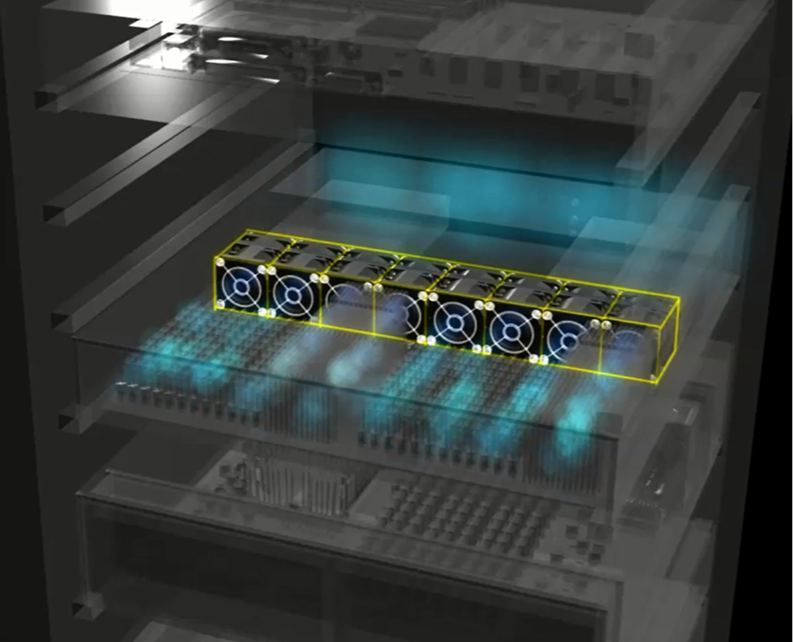
Starting with individual server chassis, there are hybrid liquid and air compute trays that split a tray’s thermal cooling demands to what’s most appropriate and efficient. Direct-to-chip cold plates can be employed handle high power GPUs, CPUs, and high bandwidth memory (HBM), which could represent 70%+ of the heat load. The remaining components can be cooled via forced-convective airflow. These non-wetted components could include network interface cards (NICs), flash or solid-state storage drives (SSD), optical components, and power electronics.
Given the growing density of compute trays, choosing a compact, high performance and high static pressure DC fan is critical to allow for adequate airflow. Another factor to consider is making the fans hot-swappable in the field in the event of a fan failure. SANYO DENKI works directly with server design teams to engineer modular field replaceable unit (FRU) fans assemblies to help with securing data center uptime.
FRUs Fan Tray Assemblies: https://coolingfans.blog/how-custom-fan-tray-assemblies-reduce-cooling-system-complexity/
Zooming out to the system and facility level: for many legacy data centers, a transition to liquid cooling would mean that the facility itself needs to be retrofitted with water systems, which can be cost-prohibitive and lengthen time-to-market. A hybrid solution is air-assisted liquid cooling (AALC).
Open Compute Project (OCP) standards outline AALC systems that have a self-contained liquid loop which doesn’t require any facility retrofitting for adopting AI and HPC servers. The AALC system is also known as a sidecar coolant distribution unit (CDU) or liquid-to-air CDU.
In an AALC system, while the liquid loop captures heat from high thermal density server racks, the thermal load is circulated to a radiator where a rack of large-frame fans draws air through the coils, rejecting the heat into the data center’s hot aisles. This combination of liquid cooling and air cooling allows AI hardware to be rapidly deployed without facility-level retrofitting.
For data centers with facility water supply lines, a similar cooling methodology can be found in rear door heat exchangers (RDHx). Sanyo Denki recently released large-frame fans that can move up to 1084 CFM per fan for these demanding applications.
Active RDHx article: https://coolingfans.blog/active-rear-door-heat-exchangers-the-role-of-fans-and-how-to-select-them/
OCP AALC source: https://www.youtube.com/watch?v=i39XIAJWTNw
For legacy, current, and future data centers, there is still a need for 100% air cooled server trays. Outside of the AI and HPC hyperscale applications, many facilities and private company server applications are not fitted for liquid cooling, due to the required facility retrofits. Whether it’s 1U, 2U, 3U server sizes or beyond, SANYO DENKI offers high performance single axial and Counter Rotating fans for various sizes and applications.
Guide to selecting fans for server racks: https://coolingfans.blog/guide-to-selecting-fans-for-1u-2u-3u-server-racks/
In summary, while the future for AI and HPC applications require liquid cooling, there are still plenty of use cases for the tried-and-true method of air cooling. SANYO DENKI’s new liquid cooling pump can support 100% liquid cooling servers to meet the rising demands pressure and flow rate optimization of the liquid loop. For hybrid liquid and air systems, SANYO DENKI has a robust line of high performance, high static pressure fans that can be designed as a hot swappable FRU. While data centers transition towards more liquid cooling, large-frame axial fans in AALC and RDHx systems can bridge the gap as a hybrid liquid and air cooling combination, saving facility retrofit costs and reducing time-to-market. For lower thermal density applications, sticking with air cooling can often be the simplest and most economical approach. Since server rack densities are ever-increasing, using high performance compact server fans, such as SANYO DENKI’s Counter Rotating fans, are crucial to meet the rising thermal demands with air cooling.
Designing a liquid-cooled, hybrid, or air-cooled system? Our engineers can help identify the right fan or pump solution for your thermal requirements.
Written by Jerry Wu
This article is part of SANYO DENKI AMERICA’s San Ace cooling engineering knowledge base, sharing practical guidance engineers use when working with DC fans in electronic cooling designs.
SANYO DENKI has been a trusted provider of cooling solutions for various industries, with fans being a crucial component in many advanced devices. Contact us for a quote, or to discuss your device's customization requirements.
Our experienced application engineers and field engineers will provide support on the customization or any other technical support for your equipment. Contact our representatives or distributors to start discussing your next project.
Contact Us
