
Cooling Fan Technology by SANYO DENKI AMERICA
This site is part of SANYO DENKI’s official cooling engineering knowledge base.
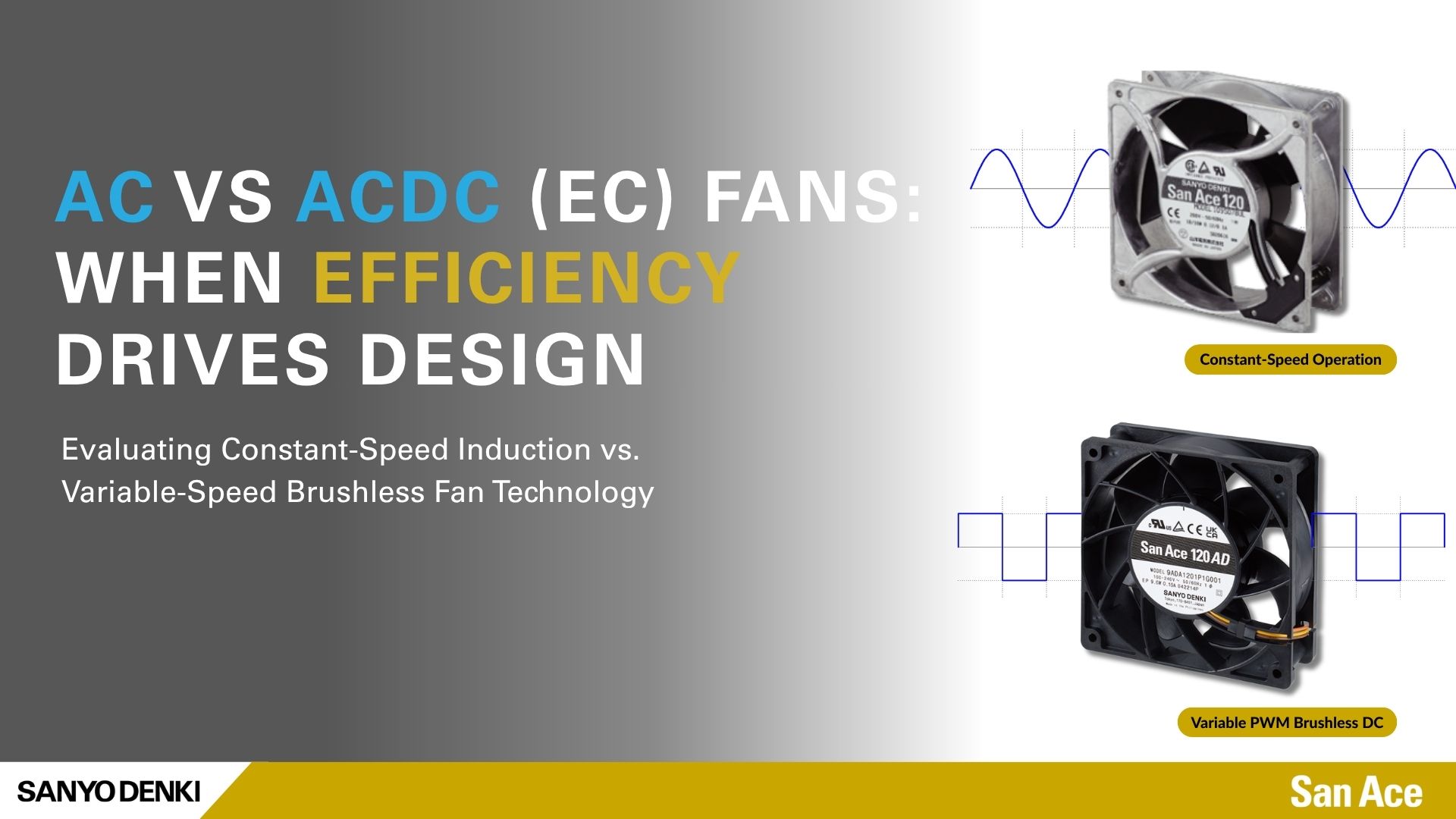
Cooling fans are traditionally selected based on key specifications such as airflow, static pressure, physical dimensions, operating voltage, and acoustic performance. These parameters remain essential; however, increasing system density and growing demands for energy efficiency have shifted the focus toward a more critical design consideration: how to achieve the required cooling performance with the least possible power consumption.
For design engineers, these differences are critical because fan efficiency directly influences system-level power consumption, thermal behavior, and operating cost. It also affects the rotational speed required to achieve target airflow, which in turn impacts overall acoustic performance.
Conventional AC fans operate using an induction motor that is directly connected to an AC power source. Because both the voltage and frequency are fixed by the AC supply, the fan cannot adjust its power consumption or airflow according to cooling demand. Induction motors also suffer from slip losses and other inherent inefficiencies, resulting in relatively low electrical efficiency. When speed control is required, external equipment such as an AC-AC inverter must be added to the power stage, which increases the overall system cost and complexity.
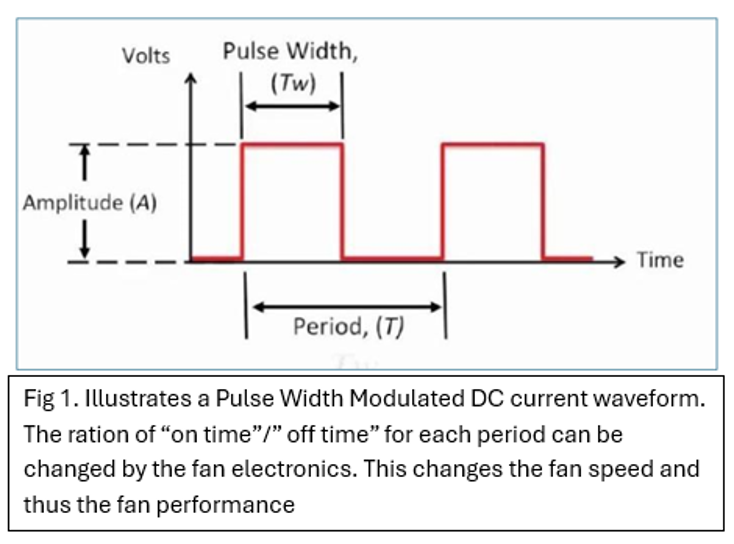
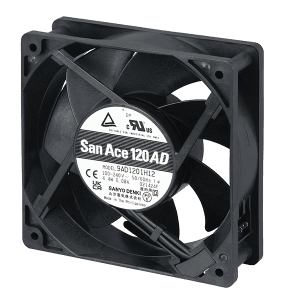
ACDC (EC) fans operate by rectifying the AC input internally to generate a DC bus, and then driving the motor using electronic control that optimizes the motor current. This structure is identical to that of a brushless DC motor (BLDC), allowing EC fans to deliver the same rotational speed and airflow as AC fans while consuming significantly less power. Furthermore, ACDC fans support PWM (Pulse Width Modulation) control. This enables the fan to adjust its rotational speed according to cooling demand, providing benefits such as reduced power consumption under partial load, lower noise levels, and prevention of unnecessary overcooling.
Figure 1. Illustrates a Pulse Width Modulated DC current waveform. The ratio of “on time/off time” for each period can be changed by the fan effectively allowing the fan speed and thus the fan performance to be changed.
If a system always requires the same amount of airflow, a simple AC fan can still be a practical choice. The problem arises when cooling demand fluctuates based on operating mode, ambient temperature, processor load, or internal enclosure conditions.
Because an AC fan continues to run at its rated speed even when cooling demand is low, it supplies more airflow than required and consumes the corresponding amount of power. ACDC (EC) fans generally have a higher initial cost than conventional AC fans; however, in applications where the fan operates continuously or for long periods, the energy savings can offset the initial cost over time. When the comparison is based not on purchase price but on total operating cost, ACDC fans can offer greater long-term value.
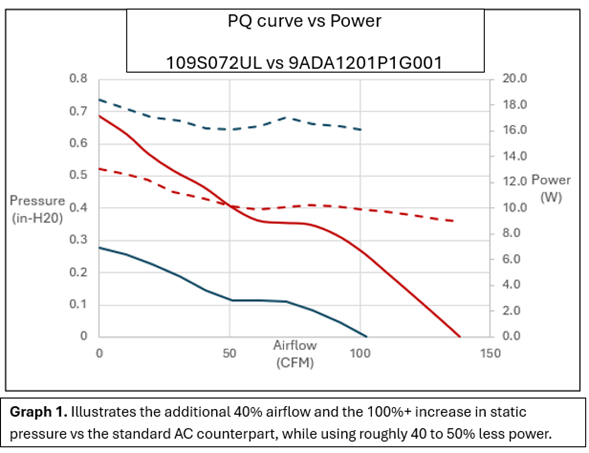
A practical way to understand the difference is to compare two fan designs with similar application intent, such as the SANYO DENKI 109S072UL AC fan and the 9ADA1201P1G001 ACDC fan.
Fan Model | Type | Voltage / Frequency | Rated Power | Current Draw | Max Airflow | Max Static Pressure |
109S072UL | AC | 230 VAC, 60 Hz | 16 W | 0.09 A | 102.5 CFM | 0.276 in-H2O |
9ADA1201P1G001 | ACDC | 100–240 VAC, 50/60 Hz | 9 W | 0.17 A | 138 CFM | 0.683 in-H2O |
Without integrated PWM control, the traditional AC fan operates at constant performance. At full speed, it produces approximately 100 CFM and consumes roughly 16 to 18 W of power. The ACDC fan, however, uses a brushless DC motor with integrated electronics and can achieve higher performance while consuming approximately 50% less power across the P-Q performance curve.
The key point is not which technology is “always superior,” but rather selecting the option that best fits the system requirements.
AC fans have supported industry for many years as simple, reliable, and cost-effective solutions for constant-speed operation. They remain a practical choice where simple, constant airflow is sufficient or where initial cost is the highest priority.
However, many modern applications demand higher energy efficiency, greater control flexibility, and more intelligent operation. By adjusting rotational speed according to actual cooling demand, ACDC fans reduce unnecessary power consumption, lower operating costs, and improve overall system efficiency. For engineers designing modern cooling systems, the important question is no longer only “How much airflow can the fan provide?” but also “How efficiently can the fan deliver that airflow throughout the equipment’s entire lifecycle?” In this respect, ACDC fan technology becomes a stronger design choice.
Learn more about San Ace ACDC Fan lineup and explore available models.
Written by Daren Perez
This article is part of SANYO DENKI AMERICA’s San Ace cooling engineering knowledge base, sharing practical guidance engineers use when working with DC fans in electronic cooling designs.
SANYO DENKI has been a trusted provider of cooling solutions for various industries, with fans being a crucial component in many advanced devices. Contact us for a quote, or to discuss your device's customization requirements.
Our experienced application engineers and field engineers will provide support on the customization or any other technical support for your equipment. Contact our representatives or distributors to start discussing your next project.
Contact Us
