
Cooling Fan Technology by SANYO DENKI AMERICA
This site is part of SANYO DENKI’s official cooling engineering knowledge base.
As data center rack power densities exceed 10 kW per rack to support HPC and AI workloads, traditional room-based cooling methods struggle to keep up. Rear door heat exchangers (RDHx) address this challenge by removing heat directly at the rack level, improving efficiency and thermal stability.
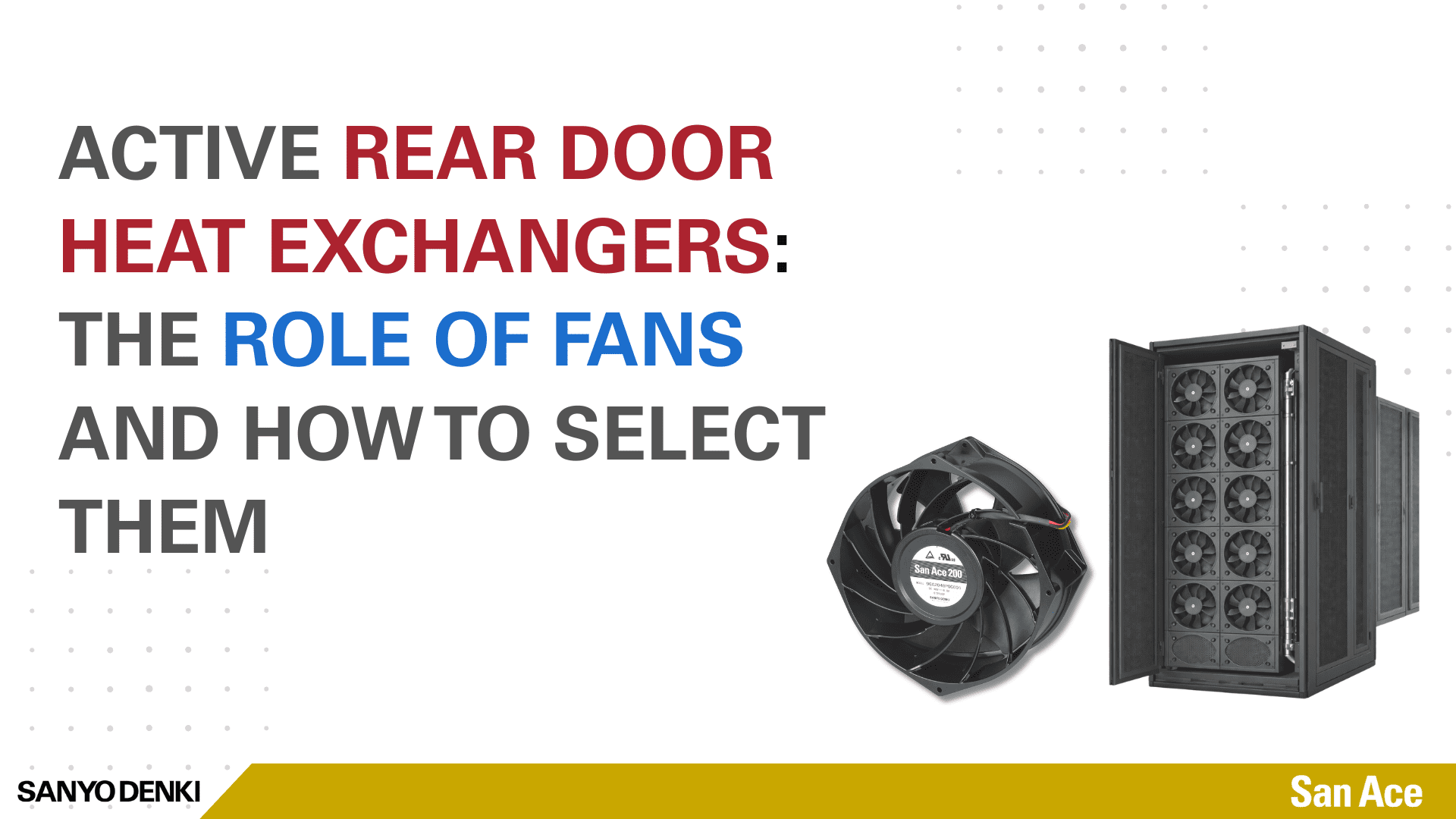
Among RDHx designs, Active rear door heat exchangers play a critical role in managing airflow and heat rejection for high-density data center environments. SANYO DENKI develops large-frame axial DC cooling fans designed to support these demanding applications, enabling scalable, controlled airflow under real operating conditions.
Rear door heat exchangers mount directly to the rear of server racks and use liquid-to-air coils to capture hot exhaust air before it re-enters the data center.
Passive RDHx rely entirely on server internal fans to push exhaust air through the heat exchanger. While energy-efficient, passive designs are typically limited to moderate rack power densities, as airflow is constrained by server fan capability and coil pressure drop.
Active RDHx remove heat by directing the rack’s air through the heat exchanger and discharging it to the outside. This approach enables:
As rack densities increase, fan selection and airflow control become critical design parameters, making Active RDHx the preferred architecture for modern AI and HPC data centers.
Active RDHx systems most commonly use axial fans.
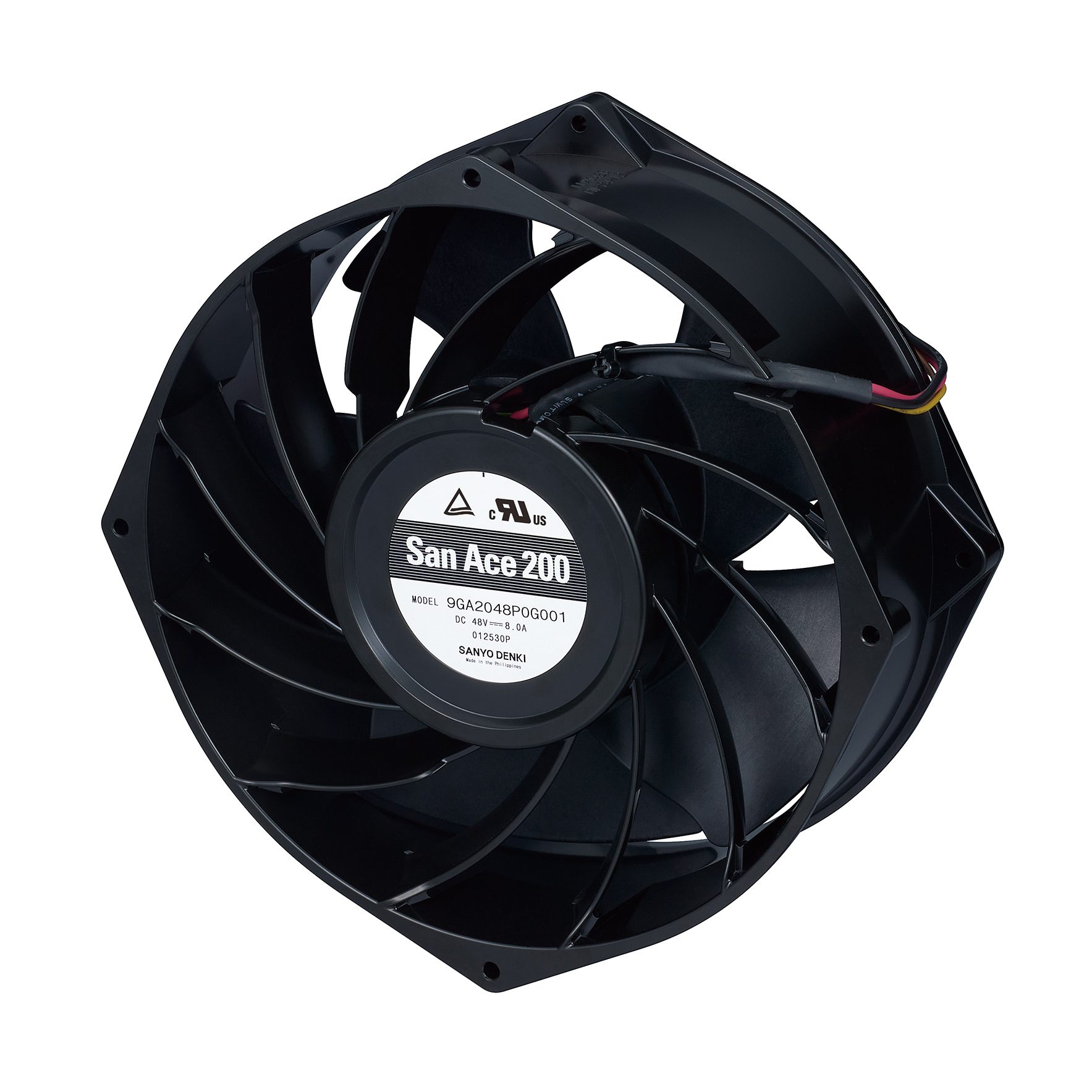
Reference Model: 9GA Type 200x70mm
Axial Fan | |
|---|---|
Model | 9GA2048P0G001 |
Frame Size | 200 mm × 70 mm |
Max Airflow (Free Air) | 1084 CFM |
Max Static Pressure | 5.40 inH₂O |
Rated Input (Free Air) | 384 W @ 48 VDC |
Noise | 81 dBA |
Note: This specification represent maximum ratings. Actual airflow and power consumption in RDHx systems depend on system impedance, and the fan operating point on the system curve.
Unlike free-air installations, RDHx fans operate against system impedance.
Typical operating airflow ranges (system-dependent):
Axial fan: approximately 700–1000 CFM
Final airflow must be confirmed using fan curves and system pressure characteristics.
9GA2048P0G001 supports PWM speed control, and the RDHx controller enables the following control functions:
This level of control is essential for mission-critical data center cooling reliability.
Axial fans provide pressure capability for dense RDHx designs.
※Fan power consumption must be evaluated at the same operating point, not under free-air conditions.
The 9GA2048P0G001 delivers high airflow and static pressure in a compact 200 mm frame, enabling:
This makes it particularly well suited for high-density rear door heat exchanger cooling.
Axial fans are best suited for high-density Active RDHx systems where airflow must be maintained against significant coil pressure loss.
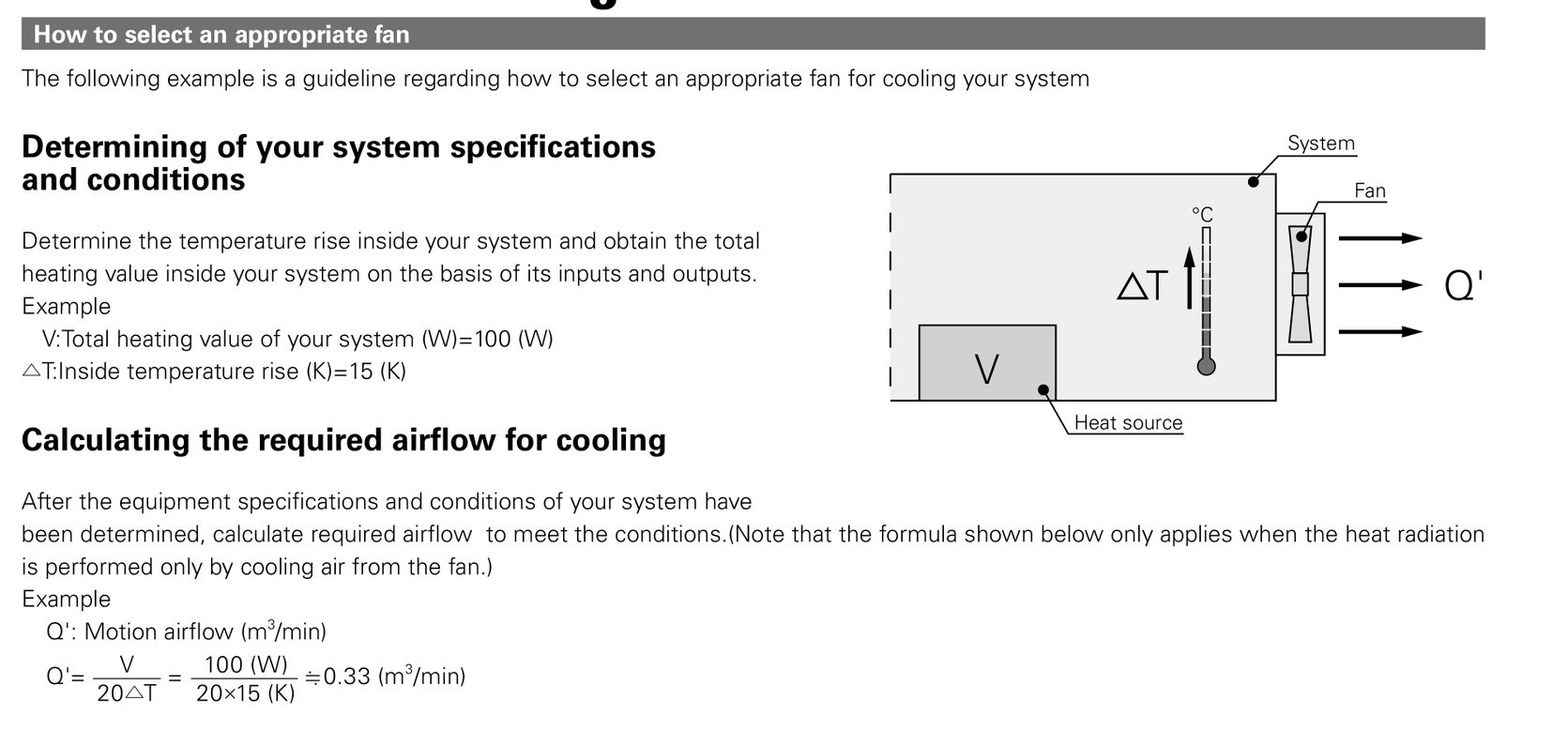
For practical Active RDHx design, airflow should be estimated based on heat removal requirements and allowable temperature rise, using manufacturer data rather than free-air assumptions.
Assuming a 10 °C temperature rise, the required airflow can be estimated as:
20 kW ÷ (20 × 10) ≈ 100 m³/min (≈ 3530 CFM)
Reference: San Ace General Catalog P617
When this airflow requirement is distributed across large RDHx fans operating against system resistance, the result typically translates to:
Important: Because RDHx fans operate against coil pressure drop and enclosure resistance, free-air airflow ratings cannot be applied directly. Designs based on a minimal fan count operating at maximum speed are generally insufficient in real installations.
As data center rack densities continue to rise, Active rear door heat exchangers require cooling fans that deliver predictable airflow, static pressure capability, controllability, and energy efficiency under real operating conditions.
The axial large-frame DC fan technologies, SANYO DENKI provides engineers with design-ready cooling solutions for modern data center and AI infrastructure—grounded in calculable performance, not assumptions.
Written by Mohammed Nassan
SANYO DENKI has been a trusted provider of cooling solutions for various industries, with fans being a crucial component in many advanced devices. Contact us for a quote, or to discuss your device's customization requirements.
Our experienced application engineers and field engineers will provide support on the customization or any other technical support for your equipment. Contact our representatives or distributors to start discussing your next project.
Contact Us
